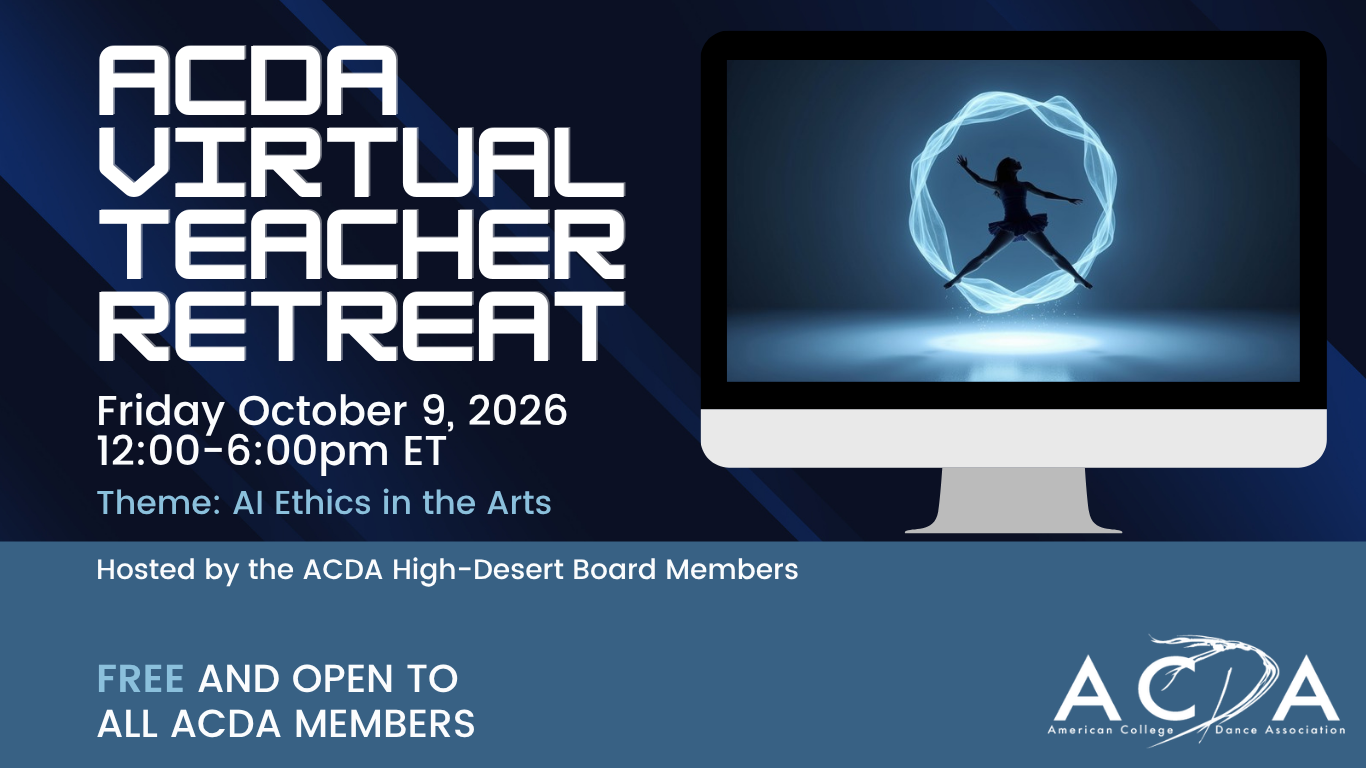
Theme: AI Ethics in the Arts
Date: October 9, 2026
Time: 12:00-6:15pm ET
Cost: Free
Hosted by: ACDA High-Desert Board Members
About: A retreat for faculty and graduate students members of ACDA. This retreat serves as a point of connection, renewal, and celebration of the incredible educators in our region. We also hope it provides an opportunity to serve our members while creating space to explore new ideas, perspectives, and possibilities together.
Schedule Overview
| Pacific/AZ | Mountain | Central | Eastern | What |
| 9:00-9:30 | 10:00-10:30 | 11:00-11:30 | 12:00-12:30 | Meet and Greet |
| 9:30-10:45 | 10:30-11:45 | 11:30-12:45 | 12:30-1:45 | Session 1 |
| 11:00-12:15 | 12:00-1:15 | 1:00-2:15 | 2:00-3:15 | Session 2 |
| 12:15-1:30 | 1:15-2:30 | 2:15-3:30 | 3:15-4:30 | Session 3/Lunch |
| 1:45-3:00 | 2:45-4:00 | 3:45-5:00 | 4:45-6:00 | Session 4 |
| 3:00-3:15 | 4:00-4:15 | 5:00-5:15 | 6:00-6:15 | Wrap Up |
Session Descriptions
Opening Meet & Greet
Session 1 – Play as a Primary Somatic Modality: Establishing a Baseline for Recuperation, Resilience, and Professional Longevity
Presenter: Sarah Donohue
Click for Class Description & Bio
Class Description: This interactive workshop offers methods for dance educators to embody recuperation and cultivate resilience through the lens of Laban/Bartenieff Movement Studies and play-based learning and will conclude with a discussion of practical pedagogical applications. The session begins with a somatic exploration of the baseline aspects of Body, Effort, Shape, and Space, guiding participants to embody grounding, breath, shape flow support, and spatial clarity. These foundational somatic components provide a vital inroad for physical resetting and recuperation. Next, the workshop provides an overview of the neurological benefits of play in pedagogical practices, focusing on embodiment of a playful mindset that can invigorate teaching and build connection with students. Participants are invited to physically manifest the qualities of play through the Laban/Bartenieff framework, specifically examining the intersection of recuperation and play within the demanding environments of teaching and academia. The session serves as a practical application of movement research, equipping participants with specific clusters of Body, Effort, Shape, and Space that foster a playful mindset within pedagogical practice and support long-term teaching resilience.
Bio: Sarah Donohue is an Associate Professor of Dance at Utah Valley University and is on faculty with Integrated Movement Studies. Sarah holds an MFA in Dance from the University of Utah and is a Certified Laban/Bartenieff Movement Analyst. Sarah danced professionally with Repertory Dance Theatre and has taught and choreographed nationally and internationally, including South Korea, Italy, and China. She is the recipient of the 2019 UVU Presidential Fellowship, Grants for Engaged Learning, the UVU Faculty Excellence Award, School of the Arts Inclusion Grants, and High Impact Practices grants. Sarah’s research explores play, somatics, and the physicality humor through a Laban/Bartenieff lens. Sarah has presented at the International Society for Humor Studies conference in Ireland, the National Dance Education Organization’s Annual conferences, the Bill Evans Somatic Dance Workshop, and The Dance Science and Somatic Educators conference. Sarah’s choreography was selected and performed at the American College Dance Association’s National Festival at the Kennedy Center.
Session 2: Panel on AI Ethics in the Arts: What does “Ethics” in AI mean? As movement artists and educators how do we enter, exit, use, and dispose of AI?
Panelists: Mike Jones, Alissa Baird, and Kenneth Collins
Read Bios
- Mike Jones: MFA in Screenwriting, Level 3 Certified AI Agent Developer through MindStudio. Mike is the founder of AI Engines and the author of the HUMAN-HEART AI Resilience Framework. His career bridges enterprise technology and education. He has served as Training Lead for international sales at Hewlett Packard (US, India, Spain, and Canada) and as Director of Technology at Schryver Medical, where he led HIPAA-compliant systems across Colorado offices. At Indiana Wesleyan University he has written courses, taught as adjunct faculty, led ed tech innovations, launched, engineered and co-hosted The Digital2Learn Podcast and a Facebook Fridays live show, produced countless course videos and documentary films, and served as Assistant Director of the National and Global Future Learning Lab. There he coached more than 250 faculty, staff, administrators, and instructional designers through AI onboarding, ethical use, and specialized AI bot builds. He also helped drive over one million dollars in avoided vendor costs by teaching himself advanced VR tools and C#, then worked with faculty and staff to build virtual reality experiences and gamified learning objects, including a complete VR city with interactive avatars for a gamified Sociology course. He has presented and taught workshops at international and national conferences, most recently OLC 2025. He is a Level 3 Certified AI Agent Developer through MindStudio, the highest tier of that program, with the build credentials to ship the same kind of agents he teaches participants to design. He holds an MFA in Screenwriting from Asbury University, a BS in Business Information Systems from Indiana Wesleyan University, and a Steadicam Operator certification. He is a U.S. Army veteran who served as an M1 Abrams turret mechanic during Desert Storm, awarded the Louisiana War Cross and three Army Achievement Medals. He lives in Marion, Indiana. His work is pedagogically sound, bridge-building by design, and built on a simple rule: AI must strengthen the human it serves, not replace them.
- Alissa Baird : Ballet West Manager of Outreach and Education BFA, Dance Performance. Alissa Baird works at the intersection of ballet, education, community outreach, and innovation. A BFA graduate in Dance Performance from The Ohio State University, she built her career as a professional dancer, dance educator, and arts administrator, with a focus that has increasingly shifted toward audience engagement and expanding access to the art form. At Ballet West, Alissa helps create programs that expand access to dance through virtual learning, technology, and meaningful community engagement. Her work is driven by a passion for making ballet more accessible and relevant to a wide range of audiences — without losing sight of the tradition and artistry at the heart of the form. She’s especially interested in how digital tools and emerging AI can support arts education, strengthen outreach efforts, and open new possibilities for connection and creativity. Alissa believes the future of arts programming isn’t about replacing tradition but about using innovation thoughtfully—to deepen impact, broaden access, and invite more people into the arts.
- Kenneth Collins: Kenneth Collins works in the gray space between the “black box” of theater and the “white cube” of the art gallery, making work at the intersection of visual art, digital media, theater, cinema, and artificial intelligence that investigates authorship, embodiment, and human expression in the age of generative media. He is best known as artistic director of Temporary Distortion (2000–present), named one of the “Best NY Theater Companies” by Time Out New York and presented in over 30 cities across 17 countries. Reflections on his work have been featured in books including La vidéo en scène: L’acteur et ses technologies, Performance & Media: Taxonomies for a Changing Field, Utopii performative: Artiști Radicali ai Scenei Americane în Secolul 21, and the theatre textbook Theatre, Brief. Academic essays on his work have appeared in Yale’s Theater, NYU’s The Drama Review, UCSD’s TheatreForum, Queen Mary’s Contemporary Theatre Review, American Theatre, Chance Magazine, and other periodicals. Collins is Assistant Professor of Film & Media Arts at the University of Utah, where he holds a shared appointment with the Scientific Computing and Imaging Institute and is a Responsible AI Faculty Fellow. In Fall 2023, he became the first professor at a university to develop and teach a dedicated course in AI filmmaking.
Session 3: Lunch And Decompression Session: Fear, Fascination & the Future: A space to share perspectives and experiences, explore ideas, and reflect on AI, policy shifts, budget realities, and the evolving role of educators.
Session 4: Post-Screen Time Restoration for the Body & Brain
Presenter: Lisa Thorngren, Certified Z Health Practitioner
Click for Class Description & Bio
Class Description: Screen time is often a necessary part of our lives and jobs, but it doesn’t have to govern our bodies and brains! Taking a movement break after a lot of screen time has many benefits to our health and well-being. In this class, after some discussion of the underlying theory, you will be guided through a series of restorative movements that will include some targeted focus on the spine, breathing structures, eyes, and inner ears. At the end of this class, you will hopefully feel more restored, and you will have a number of new exercises/ideas to use for your own post-screen time restoration.
Bio: Lisa Thorngren (MFA, BS) is an Adjunct Faculty in Dance at Scottsdale Community College, teaching technique, professional promotion, and humanities, and specializing in dance kinesiology. She has received certifications in Pilates, GYROTONIC Expansion System®, and as a Restorative Exercise Specialist through Nutritious Movement™, all of which inform her teaching practice. Lisa’s current focus is applied neuroscience, and she is pursuing education and has completed several certifications with Z-Health® Performance. She incorporates this knowledge of neuroscience and pain science in her technique (ballet, modern) and dance kinesiology classes and in one-on-one sessions with students.
ACDA’s High-Desert Regional Board created this retreat to provide members with a forum for open dialogue on artificial intelligence and its ethical implications for artistic practice and to facilitate discourse by creating space for a range of viewpoints on emerging and unsettled questions in the field. The panelists were chosen for their expertise and distinct perspectives on this topic. However, the views, opinions, and positions expressed by individual panelists are their own. They do not represent the views, positions, or official stance of ACDA, its board, staff, or membership, and should not be construed as such. In addition, panelist participation does not constitute an endorsement by ACDA of any opinion, method, technology, or organization referenced during the discussion. Presenting a topic for discussion is not an indication of institutional agreement with any conclusion reached by the panel.